Sunday, April 27, 2014

In which I attack Christian environmental apathy with GIANT BUGS!

Stardate: April 27, 2014
Second Sunday After Easter
In which I preach to attack the forces of Christian apathy in regards to stewardship of the planet. 

It's the Sunday after Easter, notably a 'low' Sunday--as in, low attendance.  I can acknowledge that while my lovely little church boasted 93 on Easter Sunday (woo hoo!), a whopping 46 were in church today--just shy of half of last week's numbers.   But it's not about the numbers!  No, it isn't, but it does feed my pastor-rage that folks don't come BACK after Easter to hear the rest of the story.  I mean, last week on Last Days of Our Lives, an earthquake damages Jesus' tomb, a special guest drops in for a chat, the guards have a serious attack of the vapors, while Jesus shows Mary(s) that he isn't really dead after all...join us this week for the next installment of Last Days of Our Lives.

 I think I just seriously dated myself there.

Anywho!  Last week ends with only the women Marys believing Jesus, and no one believes them anyway, so if you're a liturgical lectionary based church like mine, you gotta come back (preach it) to get the story of today, when Jesus all busts up in their locked-door party like "whaaaaaat, I don't need a key, Peace there honeys!  Here, lemme breathe all up on you and you can have the Holy Spurit, and with it you get the powa to forgive and retain sins!  Have fun ya'll, you be sent out like I was sent out. Peace!"

Well, I'm certain it was more solemn and serious for sure, but the point is that EASTER IS SEVEN WEEKS LONG, NOT ONE DAY.  I'll be wearing this charming white stole for almost two more months, so don't be saying that Easter is over, and you won't be making church because the garden needs planting/I need me time/last week was so much work.   sister, please.

This GIF is very accurate. In many ways.  

Ok ok.  To be fair: we...did also sorta have tornado watches today, and thunderstorms, and the picnic got cancelled and the weather was awful... so yes, there were legitimate reasons to consider abstaining from travel today.  Acknowledged. 

That said, can I say how much I seriously love the folks who DO come back, week after week, and let the story be a part of their lives?   Because sometimes, when your pastor gets so.very.tired. you need to know that just showing up can mean a lot, and I appreciate that you do.  Hey, last week WAS a lot of work, but I really enjoyed it, and what comes next isn't the falling action or resolution to the drama--it's the whole next act!  I won't begrudge those who need an intermission--but grab a snack, hit the restroom and get back here, it's just starting to get good.

What does this have to do with plastics you ask?  Well, everything and nothing.  Nothing, in that I don't have any specific comments on plastics per se, but my Lenten Plastics definitely informed the sermon today (and I didn't need to reference myself to do it.  All the sermon illustrations are 100% taken from outside sources.  Cited, even).  Lent really helped me to view concern for the environment as a legitimate and even necessary outgrowth of Christian faith--as in, if you love God and like your Christ Risen-not-buried, then you should also care about what's happening to the planet, because that's your job.

Something, something, Genesis 2:15 here.  Look it up


I really am pleased that the church has taken a serious interest in becoming a 'green' congregation, as in an "Earth Care Congregation" and you can see what that means here.  And while I know that this movement was afoot well before I came along, I'm very much in favor of it, and I want to help it succeed in all reasonable ways possible.  So my mission, which I chose to accept, was to tie together a service for the care of creation with the Resurrection--sort of a Second Sunday of Easter Meets Earth Day. 

After all my work on plastics over Lent, a genuine theological question was this one: so if Jesus' resurrection matters not just to believing Christians everywhere, but to the fabric of the universe, where is the proof?  In short, if Christ's death and resurrection destroyed the power of sin and death, why do we still see the cycle of destruction and entropy in the universe?  What gives?  Where is the power of the Resurrection for nature?  How are we going to get rid of all this PLASTIC??

And so, should you choose to read it, here is today's sermon, slightly altered so as to be easier to read than to hear. 

----------------------------

Step 1: read the scripture passage, it'll all make more sense.  Find it here, or listen to it here (it'll be the last reading, but don't worry, you'll get other lectionary A readings that tie well with the themes).  

Step 2: read the sermon.  I won't get mad if you don't.  Thanks for sticking with me this long.  :)

----------------------------


Fires and Stick Bugs and Jesus

The dangerous question for today is this:  what good is the resurrection if it doesn’t mean something AFTER Easter?  What proof is there out in the world that Jesus’ death and resurrection actually meant something profound, that tangible things are changing for the better?  Or is Jesus’ good news really just good news for a handful of believers, and not all of creation?  Did he really undo the power of sin and death, or is that just a platitude that makes for nice hymns?

This is important.  Because if you look to the natural world for evidence of what God and Jesus and the Holy Spirit are doing today, you might notice right off the bat this little thing I like to call the Environmental Crisis—whether global warming, seas rising, using too much petroleum while drowning in our own plastic trash, deforesting the Amazon, diminishing biological diversity, radiation poisoning, fracking earthquakes and smog you can see from space—it just doesn’t look like Jesus’ death and resurrection is doing much on that front.   Our souls are saved—yay!  But the earth and all on her are still doomed.

So I’d like to tell you the tale of The Giant Australian Stick Bug.   

Follow me here.  Imagine, if you will, a giant... stick... bug.  It looks a bit like a brown stick, only it is giant, about the size of your hand, and fat, kind of like a huge ant.  It’s got six legs, a big black head with scary mouth parts, and back in the 1900’s it lived on Lord Howe island off the coast of Australia.  It was so big, in fact, that explorers called them “tree lobsters”. You can't make this stuff up.  


(Here are two well-preserved specimens.  Oh, aren't they cute? 
 No. But that's not the point.  Not all nature is made of up fluff, 
sometimes it has crunchy carapaces and oversized segments.  
These are a little bit bigger than your hand)


In 1918 a British ship ran aground on Lord Howe island, and everybody had to get off the boat—including the rats, who over the course of the next two years, ate every single one of those tree lobsters, ate them right out of existence.  By 1960, no one had seen a Giant Australian Stick bug in decades and they were declared extinct, just like the dodo, the passenger pigeon, the pig-footed bandicoot and so many species of animals that go extinct when introduced to people and our vermin.  

Where is the resurrection for the pieces of creation that we kill? 

This isn’t limited to animals, we’ve gotten pretty adept at killing the land and water too—where is the resurrection of the natural world?  Easter is placed at springtime for a number of reasons, not the least of which is that it makes for very pretty pictures of flowers and bunnies and eggs-- but where is the resurrection for the ice fields of Antarctica, for nuclear testing sites, for the Gulf Coast after the BP oil spill, for Mayflower, Arkansas after the Pegasus pipeline burst right around Easter last year? 

Where is the resurrection for the land, water and air?

Did you ever hear of the river so polluted it caught fire?  You might remember the Cuyahoga River Fire of 1969.  A river in Cleveland, Ohio that was so polluted by industrial waste that it caught fire, not once, but many times; it didn’t flow, it oozed. Residents would quip that no one drowned in the Cuyahoga—they decayed.

Unfortunately, it wasn’t the only American river to regularly catch fire, so did the Passaic and the Houston Shipping Channel, even the Buffalo, to name a few.[1]  So where, in the rivers of fire, is the work of the resurrected Christ?    

Jesus walked into a locked room and announced, “Peace be unto you; as my father sent me, so I send you.”   That’s huge.  We’re being sent just like Jesus was sent.  Jesus was sent to save. We tend to want to reserve that power just for him, but part of it belongs to us too.   W tend to prefer to use today to focus on Doubting Thomas, but right before this little red-herring is something much bigger.

In John's gospel, this is Pentecost.  Jesus breathes the Holy Spirit on the disciples, and tells them “Receive the Holy Spirit. If you forgive the sins of any, they are forgiven them; if you retain the sins of any, they are retained.”     

What does that mean?

The idea of ‘retaining’ sin sounds strange.  Does this mean we don’t forgive?  I like how pastor Rolf Jacobson describes the meaning of these Greek words for 'forgive' and 'retain', because there is a physical component we miss.[2] 

Hold your hand out in front of you (go on). Now make a fist with it.  This fist retains sin; it means "to hold fast", in the sense of holding people accountable for their behavior.  Open the fist to release sin back to its proper owner.  This is a crucial dynamic for the Christian church, as all sin does damage and requires accountability. 

This isn’t a fist of anger, but a fist that seeks to hold the harm contained, whether that sin comes to us in the church in the form of rumors or sabotage, arrogance or dismissiveness, or other forms of pollution.  If we don’t hold people accountable for their sin, then we permit that sin to continue.   True forgiveness isn’t possible because the relationship continues to be damaged.  If I love you, I must hold you accountable for your sins against each other, and if you love me, it is the same.  There is forgiveness, but there is also restitution and resolution.  The results of sin must be addressed, in tangible ways.  

This is not some easy forgiveness.  This is work.

It is the power of the resurrected Christ that gives us the Holy Spirit and the responsibility to work forgiveness in the world on behalf of God—not a magical forgiveness that *poofs* away all the bad, but a forgiveness that holds all our relationships to account, to each other, and to the world.

If we do not see the resurrection in the natural world, it is because we have not claimed the power of the Holy Spirit to hold accountable and release sin as it is inflicted upon the world; a world that in Genesis, we were charged to till, maintain, steward.  How can we doubt that this is part of what it means to be Christian?  Thomas didn’t believe in Jesus until he was able to see his scars and wounds; are we really unable to see the scars and wounds inflicted on the world?    

I know you've heard "forgive and forget", but Jesus didn’t forget why he was crucified even though he forgave those who did it.  We like to pretend that forgiven sins have no more consequence, but that wouldn’t be forgiveness—that would be abuse by neglect.   
God is not neglectful of this planet.     We are. 

I know the enormity of the ecological crises invites despair, because what can one person do in the face of such suffering?  The answer is this: hold yourself and all humanity accountable for our responsibility to the world.  God created Adam and Eve to till and keep the garden; for us, the global garden needs everybody’s help.

 It can be really hard to find hope, unless you know where to look for resurrection.

When the Cuyahoga River caught fire in 1969, our nation finally paid attention to the crisis we had made during the Industrial Revolution,  and it finally sparked government protections for air and water quality.  It led to the creation of the Environmental Protection Agency and the Clean Water Act that mandated all American rivers should be “fishable and swimmable,” as the Cuyahoga is today.

 You might doubt that’s related to the resurrected Christ, unless it is the Holy Spirit at work in holding people accountable for their sins, drawing them back into right relationship.  But that's what the Spirit does. 

So back to the Giant Australian Stick Bug:

It  turns out, it wasn’t quite dead yet[3].  In 2001, two scientists trekked out to Ball’s Pyramid, a spire of igneous rock jutting over 250 feet out of the ocean about 13 miles from Lord Howe island.  This jagged cliff of rock is all that’s left of an ancient volcano, and on its sheer face clung a few scraggly bushes, and some surprisingly large piles of poop. Who made the poop?  Returning at night, a scientist and a park ranger scaled the cliffs with flashlights, and upon one bush found the last remaining Giant Australian Stick Bugs.  There were 24.  Over the next two years they fought for permission to save the bugs, and finally won permission to take 4—only 4.

Two promptly died.  The remaining two were sent to a bug specialist (that's an entomologist, but I doubted my ability to say the word correctly in front of people), and they christened the trio Adam and Eve and Patrick.  
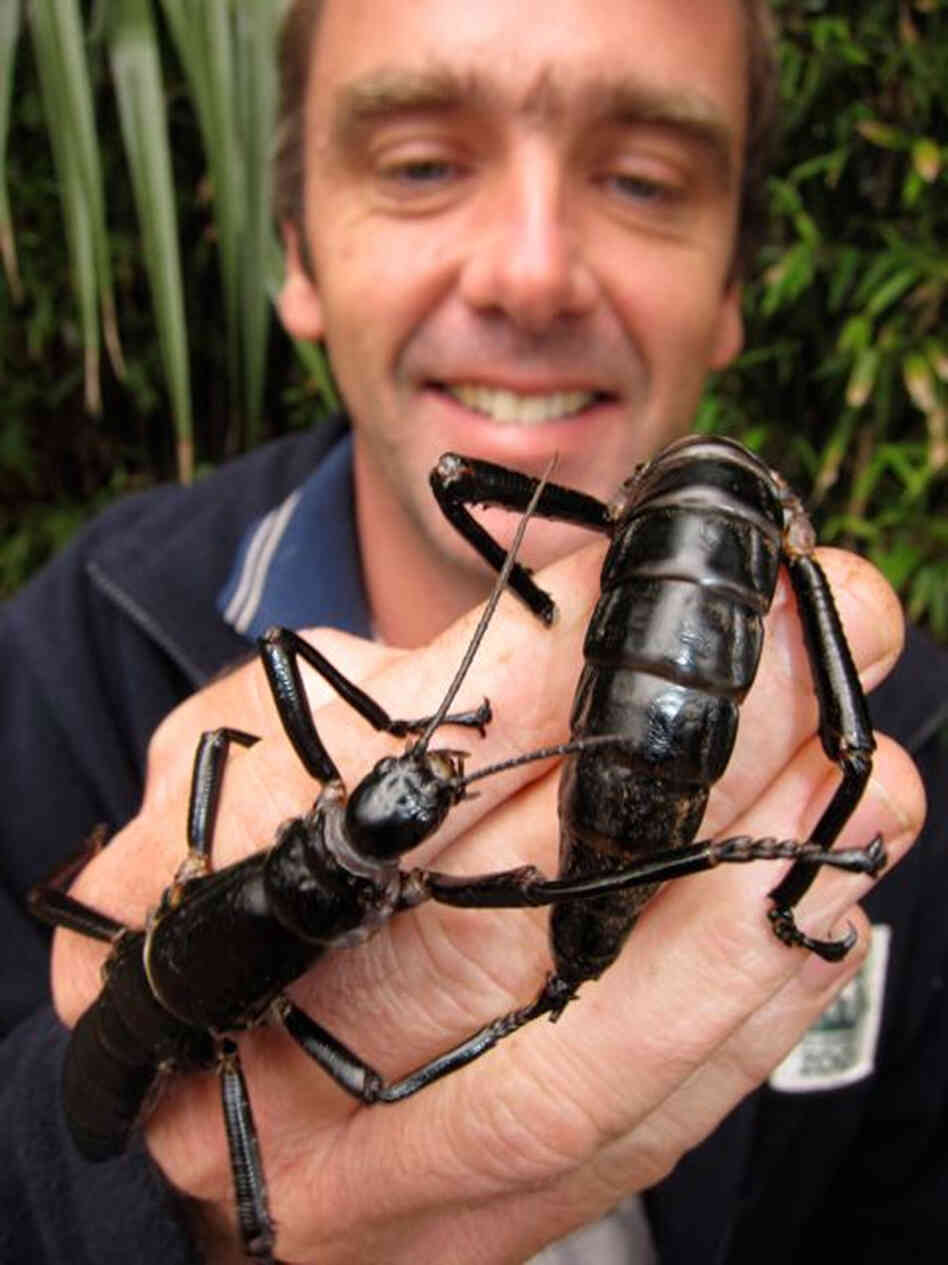
 Patrick is the guy in the middle.  The one with hands.

 Eve nearly died of malnutrition, but “intuition” helped Patrick make a syrup of calcium and nectar. He fed her drop by drop, like a kitten curled in his hand.  A big, brown, six legged kitten.  But she lived.

And she laid eggs!  30 hatched.  By 2008 there were over 11,000 eggs in incubation and over 700 adults in captivity.   The challenge now--right now-- is this: can they return the Giant Australian Stick Bug to its original habitat on Lord Howe island?  Because first they’d have to wipe out the entire rat population, and then convince the human islanders to welcome back giant hard shelled insects because they belong there. 

Who wouldn't want a yard full of giant bugs?  Why not see one next to the toilet at night?

No really though.   Will we ‘save’ them, if it's in our power, or will we keep them museums?  We have the power.  What will we do?

This isn’t just a conservation story.  It’s a question about whether we as a human race are going to reclaim our role as stewards of the planet because we believe in the resurrection.  Whether our belief in a resurrected Christ translates to a belief that resurrection is possible for the world itself—not the annual rejuvenation of Spring, but an actual return from the dead.  Can we help bring to life that which we kill?

It’s a question about whether we are prepared to receive the Holy Spirit, to forgive and retain the sins of others and ourselves.  We have a great responsibility to hold ourselves and others responsible for what we have done.  There is no forgiveness with mere forgetting, no release without work.

The resurrection matters to the natural world, but only when it matters to us.  

May we receive the Spirit, and find more resurrection.  Amen.


[3] http://www.npr.org/blogs/krulwich/2012/02/24/147367644/six-legged-giant-finds-secret-hideaway-hides-for-80-years


Not in love with the idea of baby Giant Australian Stick Bugs yet?
awwww.  You should sit back and watch this for six minutes.
It's very chill.  

What would Jesus do?
He'd totally hug a stick bug.  Very gently. 

Tuesday, April 22, 2014

return of the plastics blog!

Stardate: April 22, 2014
Two days after Easter
In which I finally get around to doing what I said I'd do, and organize all this plastic I've been saving.

Well, I can't tell you the volume of plastics I saved over the course of Lent, because I don't have a scale in this house and I aim to keep it that way.  But I did just spend two hours sorting, to the best of my ability, all the plastics that we saved.

Wooooo Nelly!   I've made a righteous mess.

So before I share the pictures, I think it only fair to admit a few things:
1) I'm not done with this experiment.  Not by a long shot.  This is the first time in my life that a Lenten practice has profoundly changed my worldview.  I might stack this up there with that time I became vegetarian in college for Lent, cause that stuck for 6 years, but this worldview shift has me thinking deeply about the earth, plastics, ecology and a whole host of other stuff almost all the time--at least several times a day.  And it isn't guilt driven either, but more of an awareness.  So, yeah.

2) Here's my plan.  I'll post all the pictures tonight and call it good.  Then I'll go type by type into an discussion of the sorted final stage, and recycle those items (or not) afterwards.   Then I'll have a set of stuff that still isn't sorted because I don't know what it is and I think I have a good chance of finding out.  This includes: bottle tops, zip ties, green army men, forks and spoons, deodorant bottles, cereal bags and a recorder. THEN I hope to make a trip out to the recycling center to get more questions answered.  Hopefully by that point I'll have further direction

3) I have a short list of take-aways:
  - styrofoam is eeeeevil, and it will take a good deal of convincing to convince me otherwise.
  - medical grade plastic is amazing
  - so are plant based plastics
  - There is a lot that CAN be recycled that isn't.  I rather want to know what it would take to change that.

that said, heeeeeeere's all the plastic from 40 days of Lent!!  (Cue the music!)
Plastics #1 Bottles, bottles, more bottles.

Plastics #2 Mostly Milk bottles. Of varying sizes.  Some straws.

My only Plastics #3--the wrappers on biodegradable pots.  Who'd have thunk?

Plastics #4 Mostly Bread bags.  Seriously.  That's all that's in there.  I have some guilt knowing that if I'd just NOT been lazy/busy/mom to a toddler AND a pastor AND a wife and baked a ton of bread I could have avoided all of this...of course, it DID all fit into one bag and it's really light.

Plastics #5 Mostly dairy products, some cups and take out.

The eeeeevil plastic #6.  Styrofoam cups, meat packs, and Starbucks/coffee lids

The troubling mass of plastics #7 and beyond...what IS most of this stuff??  Big questions: cereal baggies, chip baggies, coffee baggies, cheese wrappers, food wrappers.  


And then these charmers for the night:
While I fully expected these tiny yogurt containers to be #5 like all their kin, the label gleefully informs me that they are made of plant plastics.  The question is then: does it still recycle?  or should I try to compost that?

Seriously ya'll, my kitchen is covered in trash. 

I mean, valid spiritual inquiry.  
My kitchen is covered in valid spiritual inquiry that is too massive to fit in the recycling bin.  
One thing at a time!!

Peace be upon you in your Eastertide.
Marie


Thursday, April 10, 2014

In which I remember that plastic Easter Eggs are made of plastic

Stardate: April 10, 2014
37th day of Lent
In which I belatedly remembered plastic Easter Eggs are, in fact, made of plastic.

So, like many parents out there, I find myself preparing for Easter.   This is not without some degree of emotional baggage, which I feel compelled to share because there's a point in here somewhere.

Let me be clear:  I adore Easter.  It is, hands down, my favorite holiday, soundly beating out the close tie between Thanksgiving and Halloween, and just tar-and-feathering the heresy that is the modern celebration of "Christmas".  Don't get me started on THAT one.

I LOVE Easter.  I love Holy Week running up to it, I love telling the story, I love finding new insights, I love Easter Baskets and Easter Candy and Easter Egg Hunts.  I especially love the delicious (literally, in the case of chocolate bunnies) irony of the Christian holiday of resurrection having out-and-out stolen the pagan Spring holiday of fertility (I used to be able to explain this better, but my children's incubation caused massive brain damage, so now I stick with "it was a great marketing plan").  And when I'm not tired as all get out, I LOVE our celebration of it, The Easter Feaster.

AH, Easter Feaster!   "Jesus rose so we could chow down."  Ok, obviously it's more elegant than that, but the Easter Feaster is a no-holds-barred, throw down, make-your-momma-proud potluck par excellance, Bring Your Own Beer/Wine/Grog to share with the heathens, we're going to ENJOY the joy that is living.  You invite EVERYBODY, especially those who don't come to church (with promises --that are kept!--of no proselytizing, only pie, unless THEY ask first, which they will), there are too many people, waaaaaay too much food, and somewhere in the 7th hour of the feast, when all are in their cups and the kids have been trundled off to bed, folks start talking about what they REALLY think about Jesus, Christianity, "those people", life, death, suffering and this idea of resurrection.  Every year we've ever held it has been beautiful, amazing, soul filling, life affirming and wonderful.  Fights!  Songs!  Laughter!  Hangover!  It's a party I genuinely believe makes Jesus proud.

I am not kidding, it is the Kingdom of God right there in the living room.  It is my favorite day of the year.

So please, weep with me:

I am just too tired to do it.

Sure, there are reasons, but the biggest is that the idea of throwing my favorite party of the year fills me with dread, because I just don't have the energy to do it.  This has never happened to me before.

I realized all this yesterday while in the grocery store, trying to remember what food we needed before dashing back home to continue juggling my life.  Because Holy Week is coming.  I love Holy Week...but everything else comes to a screeching halt, and just keeping myself and the kids clean, fed and dressed is about all I can handle.  Party planning?  My darling, something must give.

See Steve Carrell explain it here.

I stood there, in front of a display of gleaming, shiny Easter Eggs, trying to remember why I needed to buy them and realized that I barely had the brains to do the math: the two dozen eggs for the hunt...plus two dozen real eggs to boil and dye at home...wait, oh no! I still need to buy the giant leg of organic, grass fed, happy baby lamb to roast in oranges and mint for the party, plus the strawberry cake and coconut for my traditional "Baby Lamb Cake" for the party (it bleeds strawberry jam when you cut it; it is awe-some) and at least 4 boxes of Quorn cutlets for my prize winning Faux Fried Chicken for the party, plus where can I find 5 giant boxes of the good Kosher Matzoh bread for the party and invitations and beer and wine and people for the party...plus I need to review Maundy Thursday's music and what on earth am I going to preach that day, at least Good Friday is already set but OH MY SWEET LORD NEXT WEEK IS EASTER AND WHAT AM I GOING TO PREACH on the highest, holiest, most importantest day of the year?

...there is no way I can do this party.  My favorite party.  It cannot be.

So I kinda teared up in front of the Easter Egg display, because these eggs and maybe a few baskets for the kids is about all I can muster this time around.  And package in hand, what thought sings through my mind like a bell?

"Those eggs are plastic."

Curse words may have been said, but we needn't dwell on them.

By this point I was a tad, shall we say, grumpy, so I shoved two packages in my cart and promptly shoved it out of my mind.  Like I said, something has to give.

But I found the cutest organic-fancy-pants-feel-good-tasty lollypops to go IN them today, and that cheered me up, and I thought: OK.  Let's just do what we can, and it's alright.  Maybe someone ELSE will want to host the Easter Feaster (open opportunity! Don't be shy!)  And if not, then now we know: next year we start the plan with the party, and all will be well.

So back to the eggs, and all the usual questions:  what are these things made of?  Titled: Holiday Home 12 Iridescent Bright Eggs, the eggs themselves have no markings (but disturbingly, DO have air holes punched in them. What does one hide in an egg that needs air holes?).  The package helpfully says the following: "Distributed by Inter-American Products, Cincinatti, OH 45202.  Made in Ningbo, China."  as well as "Wash product thoroughly before filling with food."  ooooo.

 Then, oddly, my usual Google search turns up...very little, actually.

Computer: Google "What are plastic easter eggs made of"
Results:  mostly sales of such and surprisingly little else.  One article from a day ago
"Ask Eartha: Unwanted surprise nested in plastic Easter eggs" is actually unreadable for some reason (no really, all the words are blanks, like some psychopathic game of Hangman involving the entire article) and you can also see the website for Eco Eggs, an American Made answer to those awful Chinese plastic eggs from overseas--bigger (Amurican Made), plant based, more expensive but morally superior; order them here!  (Ok, I'm probably going to order them, but not now, on principal--the principal that I just bought eggs and your marketing strategy required that I find You).

We took bets on what sort of plastic we thought most eggs were made of.  I bet #2, as molded and colored and readily available, but our friend L bet #6 as styrene is easy and cheap, and hubby thought #7 "other" best matched China's stellar record of quality control.  Who won?

Well... according to a few sites, "Plastic eggs CAN be recycled curbside in your recycling bin or cart. Simply place cleaned and emptied eggs among your other mixed recyclables." but they don't cite how or why.  Wiki Answers said yes but in such a stupid fashion that I refuse to publish the link.  Then again, this totally legit site  "Answerbag" said no, again without reason or justification.  Pinterest and innumerable craft sites will help you make inane objects out of plastic eggs, but offer no real direction for actual recycling.

Of course, I actually learned a whole lot about Easter Eggs from Wikipedia, and someday really should send them a contribution or something before they are destroyed by net-non-neutrality.  No, seriously, if you click nothing, click the above link, even if it doesn't say a blessed thing about plastic eggs at all.

ACTUALLY, I HAD TROUBLE FINDING ANY INFORMATION ON THE RESIN CONTENT OF PLASTIC EGGS AT ALL.  IT IS, SO FAR, THE MOST CHALLENGING QUESTION I'VE TRIED TO ANSWER.  Which is dumb if you ask me.

...so a pause to indicate the inordinate amount of time I spent looking for this information.


-----
-----

-----
-----
Ah, here's a blog that has me beat for sanctimoniousness, "My plastic free life".  Actually, she seems pretty interesting, maybe I'll have to follow her before being all judgey.  Alas, she does not know plastic resin type either.

-----

And then, at long last,  no really this took an hour, success!!

I finally start looking up an actual Chinese manufacturers, and eventually one of them notes that the material is "PP".  I think that means "Polyproplyene".  Thank you, Global Sources Manufacturing.  What is it?

Hat tip to WiseGeek, again:
Also known as PP resin, Polypropylene resin is a synthetic polymer that can be used to create a wide range of products. This polymer is made from a combination of propylene and other materials that in decades past were considered to be waste material. Since the development of polypropylene resin during the middle of the 20th century, the resin has been used to make such diverse products as upholstery for car seats and home furnishings, loudspeaker covers, and a number of plastic items for use around the home as well as in the laboratory.
There are several benefits to polypropylene resin that set it apart from other plastics and plastic blends. One has to do with durability. This type of resin can stand up to a great deal of wear and tear, making it ideal for products that see a great deal of usage on a daily basis. For example, plastic dishes and drinking cups made with this type of resin will hold up well in the dishwasher without warping or degrading in any manner. The dishes can easily be used for a number of years with no apparent signs of wear.
Does it recycle?  YES!   Welcome to our introduction to plastic #5!  (Sorry to those betting, looks like the house wins again).  
According to Earth911:
You’ve probably got plastic #5 in your refrigerator or medicine cabinet right now. Common packaging made from polypropylene includes containers for:
  • Cottage cheese
  • Yogurt
  • Cream cheese
  • Ricotta cheese
  • Margarine
  • Hummus
  • Medicine bottles
  • Some plastic ice cream containers
  • Food storage and take-out containers
  • And if your local waste management/recycling program doesn't take #5, most Whole Foods locations do! 
Well, by far the most useful website on #5 comes from azom.com, which helpfully provides the following information:
Polypropylene (PP) is a thermoplastic polymer of the monomer propylene. It is a robust material and has high resistance to acids, bases, and other solvents making it extremely useful for a range of applications.
Molecular formula - (C3H6)n
Density - 0.946 g/cm3, crystalline
Melting point - 130°C (266°F) (hot!)
MFR (Melt Flow Rate) - 5 - 6 (huh?)
IUPAC id - poly(propene) (I think this is industry code)

Chemical and Physical Properties of PP

Polypropylene is typically an isostatic polymer (all substituent macromolecules are located on the same side of the molecular backbone – typically in a semicrystalline form). A tough, fatigue resistance and flexible plastic, polypropylene has a diverse range of applications from packaging to engineering. Easily customizable for colour, strength, etc., polypropylene can also be made translucent. (Hence, Easter Eggs!)

Current Applications of Virgin PP Material

PP is widely used and the major applications of virgin PP are in the following areas:
  • Packaging and labeling
  • Textiles - thermal underwear, ropes, and carpets
  • Reusable containers
  • Plastic parts
  • Stationery
  • Laboratory equipment
  • Loudspeakers
  • Automotive components
  • Polymer banknotes

Environmental Impact of Non-Recycled Plastics

PP and other plastics are widely used in packaging and other industries, thanks to their heat and chemical resistance. Polypropylene is extensively used in containers for hot liquids, as it has a high melting point. However, because of the short life span of packaging, most of these thermoplastics are thrown out as waste and end up in landfills. The US Environmental Protection Agency estimates that about 20% of municipal solid waste comprises plastics in some form.

PP products degrade very slowly in landfills and take about 20 to 30 years to fully decompose. (But at least they do?)  This poses a serious problem because of the additives in plastic products, which include stabilizers, colorants, and plasticizers. (oh, it's bad they decompose). These additives can contain a range of toxins including  cadmium and lead. According to studies, plastics can account for about 28% of the total cadmium in solid municipal wastes in studied landfills, which has the potential to leach into other systems with potentially harmful consequences for a range of biosystems. (Yes, bad.) Moreover, burning of thermoplastics can release toxins such as vinyl chloride and dioxins, and this makes atmospheric pollution a real issue to consider.

Hence there is a compelling need to prevent thermoplastic products finding their way into our municipal waste streams, landfills or incinerators. Recycling of PP is much needed and is a cost-effective and eco-friendly way of managing plastics throughout life. Also, since PP is a petroleum based product, recycling of these products will help us preserve our oil / petroleum resources.

Recycling Process (Hey!  Look!  This is the first time this has been explained to me!)

A uniform code for the recycling of plastics was first introduced in 1988 by the Society of the Plastics Industry. (Yes, we know them).  The code was designed to make the identification of certain plastic resins easier to enable a more efficient and precise sorting stage, which would then result in more efficient recycling as specific methods apply to different types of plastics.
Plastic products are now printed with Numbers 1-7 depending on the type of plastic and the resin fundamental in its production.
Polypropylene (PP) is increasingly being recycled. With diverse applications in a range of single-use packaging products such as bottles, yogurt containers, medicine bottles, caps, straw (aha! Straws!  Another mystery solved), plastic cups and food packaging, etc, we are increasingly using more PP and thus generating extraordinarily big volumes of rubbish made from PP.

Recycling of polypropylene products involves the following steps:
  • Collection - This involves accumulating used plastic products from the domestic municipal waste stream. This is usually mixed plastic waste in which all types of plastic products will be present. (A-yup, sounds like ours)
  • Sorting - The sorting process involves separation of PP products from products made of other types of plastics, based on their recycling codes.  (I'm still curious about this 'sorting' step--who does it?  How?  Do they use robots?)
  • Cleaning – In this step, paper labels and coloured pails are removed (what?  What's a coloured pail?  Why the extra 'u' in the word), then the products are granulated and washed which gives rise to “clean flake”. This flake is converted to uniformly sized pellets for easy feeding into extruder or moulder.
  • Reprocessing by melting – Here, the pellets are then fed into an extruder where it is melted at 240oC (464oF) and cut into small granules which are now ready to use in making new products. (Yes!  Melting!)
  • Creating new products using the recycled PP – In this step, key parameters of the recycled material such as the melt flow index are measured to assess their suitability for use in different applications. Depending upon these properties, the recycled PP is moulded into various products.

There are four main types of recycling processes for PP: (Behold!)
Primary – The primary recycling process is feasible only for industrial plastic wastes, and hence this is not a widely used process.
Secondary – Secondary recycling can be used in recycling of a combination of plastic wastes and gives rise to products such as fenceposts, which can be used instead of concrete, wood, and metal.
Tertiary – Tertiary recycling process is a widely used recycling process and produces chemical and fuels from waste plastics.
Quaternary – Quaternary recycling process involves incineration of plastic wastes at very high temperatures of up to 900 to 1000oC (1652 to 1832oF).  The left over materials from this recycling process are sent to landfills. The use of incinerators is highly helpful as they prevent the release of pollutants into the atmosphere and also they reduce the amount of incoming waste by about 80% wt and 90% vol.  (Wait.  This step doesn't seem like recycling.  It seems like a controlled burn.  That's not recycling--it's burning; much as one does not 'recycle' polystyrene into Napalm.  That's not recycling, it's weaponizing).

Applications of Recycled PP

Recycled polypropelene is currently used in the manufacture of the following products:
  • Battery cables
  • Brushes
  • Ice scrapers (this seems very specific).
  • Pallets and trays
  • Landscape borders
  • Signal lights
  • Brooms
  • Auto battery cases
  • Bicycle racks
  • Rakes and bins
As we refine our manufacturing and recycling processes, many more sustainable and innovative uses for recycled plastics are being developed. Companies are trying to re-use their plastic waste themselves without looping them through recyclers, which is a very encouraging step forward as it saves massive recycling cost. More extensive research needs to be conducted in the field of recycling and re-using of plastics, which will hopefully pave the way for many new opportunities in this arena.

Sources

http://www.lotfi.net/recycle/plastic.html
http://www.bpf.co.uk/sustainability/plastics_recycling.aspx
http://machias.edu/assets/files/posters/plasticrecyclingchart.pdf
http://www.bpf.co.uk/plastipedia/polymers/pp.aspx
http://bura.brunel.ac.uk/bitstream/2438/4750/1/Fulltext.pdf
http://www.recoup.org/shop/product_documents/147.pdf

So, all told, this is a very long post that took a great deal of time but probably makes up for a few days of radio silence.  Those plastic eggs DO recycle, at least around here, but probably into ice scrapers that you'll manage to break just when you really need them anyway.

Does Jesus care?
    Honestly, I think Jesus is a little appalled that we'd celebrate his resurrection with little plastic toys with such a shady second life of their own, but still the tradition of hunting eggs is charming enough for children.  Maybe your mom was wrong, and it's totally ok to hunt REAL eggs so long as you don't break them and wash them well before eating.  

   I think though, Jesus might be bummed that we don't REALLY get down and celebrate in a more serious way; I guess I'm sorta feeling guilty that my Easter celebration this year is cut short.  So here's my ask: if anyone who knows me and is nearby wants to host an Easter Feaster, man I am totally down with that.  I'll bring the stawberry lamb cake.  OR if you're having a big Easter dinner with family, maybe you can invite some folks you don't know well to join you and see where it leads.  'Cause if it's true--that's the rub, ain't it?--IF it's true that God really does love us more than we can imagine, and IF God took all the steps possible to undo the mess we made for ourselves, and IF God did in fact undo the power of sin and death for us, then Easter is the most awesome, ballsy, ridiculous come-from-behind story I know.   And it deserves the party where people get honest with each other, and ask the pointed questions.

I'll tell you something terribly honest:  I choose to believe this. I didn't exactly grow up thinking it made sense.   I study the dang thing, and learn more every time I do so, and I'll admit that sometimes the dots don't seem to connect well to a modern mind and human error gets in the way all over the place.  If you read the Bible literally, I'm sorry for you, because this Palm Sunday's reading from Matthew has Jesus riding two animals at once and a sermon on Jesus as Circus Rider doesn't always go over well.  But I'll also share this: that in choosing to believe that God loves me enough to do crazy, unthinkable things (like traipsing into an occupied city with witty street theatre as a means of challenging the oligarchy and death itself), it frees me up to do crazy, unthinkable things too.  There is a freedom born of the trust that says "I think God's got this, so I don't have to."  I don't have to host a party in the hopes that someone might witness God's grace and mercy between the beer and the cheese dip...God's got this.

I just need to enjoy the ride, and keep pointing to where the party is at.  
And in honor of Passover, it is "next year in Jerusalem!"

Much love,
Peacefully,
Marie

Friday, April 4, 2014

Dumpsters are not always for diving

Stardate: 4/4/2013
31st day of Lent
In which my beloved endures a difficult part of his day.

Earlier this month I visited my beloved husband at work, where he showed me the work he'd been doing building the set for an upcoming show.  The set is composed mostly of a large, life size(ish) castle, and he elected to do the 'stone' walls out of insulation foam.  This is the form of large pink sheets--yes the kind with the Pink Panther on it, FORMULAR, made of extruded polystyrene (also known as the infamous #6).  I know this material as most easily molded by using some sort of ketone solvent to carve out 'natural' looking stones and rough facing.  That's how we did it in my day, fumes aside, cause theatre techies are hard core, even as this method causes poison gas. So my beloved had wisely chosen to simply carve the foam with a wire wheel on a drill.  Unfortunately, this also creates a quite generous amount dust.

Here begins our tale.

"I... had a lapse of judgement. It was five minutes before the end of Theatre practicum class, and we needed to clean up the mess of scenery construction before the next class.

 We were vacuuming up a pile of saw and foam dust and discovered that the shop vac was full.  My lapse of judgement came when I thought, "I know.  I'll save a plastic bag and just dump the contents of the shop vac directly into the dumpster."  So I rolled the shop vac to the dumpster, which was about half full, and proceeded to lift it off the ground to dump the contents inside.

But I lost control of the shop vac, and half of the contents spilled out on me: covering my shirt, filling my shoes and landing in a pile in the parking lot. Inexplicably, much of the dust had become wet--how I do not know--and stuck to me.  Saw dust is tan.  Foam dust is pink.

And then the wind came.

This is what made me realize my mistake; that when the dumpster gets dumped, the contents that I would have put into a plastic bag would instead simply be scattered to the four winds, causing more problems than if I'd just put it in the stupid plastic bag in the first place.

Furthermore, upon losing control of the shop vac, it fell in such a way that one of the wheels popped off.

It bounced, slowly and carefully, first along the rim and then from once piece of trash to the other, then gracefully rolling its way down into the furthest bottom corner of the at least half full dumpster--the contents of which included copious amounts of saw dust, foam dust, and fresh cafeteria waste.  So five minutes before my 14 speech students arrive expecting a sparkling clean classroom and teacher, I am covered in pink fairy foam dust and considering diving into a dumpster for a single small wheel.

My first thought was, "Oh I'll just leave it.  I'll be fine with a shop vac that never rolls quite right."
My second thought was, "No, I won't. I don't have the money to replace it, and I know that if it rolls funny, I'll want to replace it."
My third thought was, "Oh no.  The wheel is plastic."

I'm going in.

I climbed into the dumpster, fished out the wheel, and put it back on. It is a minor miracle that I only stained my sleeve with something brown. I hope it comes out.   I dusted off the sawdust, scooped up the pile in the parking lot, and put it back in the dumpster--knowing full well that everything would have gone a lot better if I'd just used a plastic bag.

Look.  I still can't get it out of my socks."


Ah, my beloved.  This is why we went with the poison gas, back in my day, back in Camelot.
Points to anyone who has known us long enough to get the reference!

May your discernment of plastics lead you to wise choices.
Peacefully,
Marie