Second Sunday After Easter
In which I preach to attack the forces of Christian apathy in regards to stewardship of the planet.
It's the Sunday after Easter, notably a 'low' Sunday--as in, low attendance. I can acknowledge that while my lovely little church boasted 93 on Easter Sunday (woo hoo!), a whopping 46 were in church today--just shy of half of last week's numbers. But it's not about the numbers! No, it isn't, but it does feed my pastor-rage that folks don't come BACK after Easter to hear the rest of the story. I mean, last week on Last Days of Our Lives, an earthquake damages Jesus' tomb, a special guest drops in for a chat, the guards have a serious attack of the vapors, while Jesus shows Mary(s) that he isn't really dead after all...join us this week for the next installment of Last Days of Our Lives.
I think I just seriously dated myself there.
Anywho! Last week ends with only the women Marys believing Jesus, and no one believes them anyway, so if you're a liturgical lectionary based church like mine, you gotta come back (preach it) to get the story of today, when Jesus all busts up in their locked-door party like "whaaaaaat, I don't need a key, Peace there honeys! Here, lemme breathe all up on you and you can have the Holy Spurit, and with it you get the powa to forgive and retain sins! Have fun ya'll, you be sent out like I was sent out. Peace!"
Well, I'm certain it was more solemn and serious for sure, but the point is that EASTER IS SEVEN WEEKS LONG, NOT ONE DAY. I'll be wearing this charming white stole for almost two more months, so don't be saying that Easter is over, and you won't be making church because the garden needs planting/I need me time/last week was so much work. sister, please.
This GIF is very accurate. In many ways.
Ok ok. To be fair: we...did also sorta have tornado watches today, and thunderstorms, and the picnic got cancelled and the weather was awful... so yes, there were legitimate reasons to consider abstaining from travel today. Acknowledged.
That said, can I say how much I seriously love the folks who DO come back, week after week, and let the story be a part of their lives? Because sometimes, when your pastor gets so.very.tired. you need to know that just showing up can mean a lot, and I appreciate that you do. Hey, last week WAS a lot of work, but I really enjoyed it, and what comes next isn't the falling action or resolution to the drama--it's the whole next act! I won't begrudge those who need an intermission--but grab a snack, hit the restroom and get back here, it's just starting to get good.
What does this have to do with plastics you ask? Well, everything and nothing. Nothing, in that I don't have any specific comments on plastics per se, but my Lenten Plastics definitely informed the sermon today (and I didn't need to reference myself to do it. All the sermon illustrations are 100% taken from outside sources. Cited, even). Lent really helped me to view concern for the environment as a legitimate and even necessary outgrowth of Christian faith--as in, if you love God and like your Christ Risen-not-buried, then you should also care about what's happening to the planet, because that's your job.
Something, something, Genesis 2:15 here. Look it up.
I really am pleased that the church has taken a serious interest in becoming a 'green' congregation, as in an "Earth Care Congregation" and you can see what that means here. And while I know that this movement was afoot well before I came along, I'm very much in favor of it, and I want to help it succeed in all reasonable ways possible. So my mission, which I chose to accept, was to tie together a service for the care of creation with the Resurrection--sort of a Second Sunday of Easter Meets Earth Day.
After all my work on plastics over Lent, a genuine theological question was this one: so if Jesus' resurrection matters not just to believing Christians everywhere, but to the fabric of the universe, where is the proof? In short, if Christ's death and resurrection destroyed the power of sin and death, why do we still see the cycle of destruction and entropy in the universe? What gives? Where is the power of the Resurrection for nature? How are we going to get rid of all this PLASTIC??
And so, should you choose to read it, here is today's sermon, slightly altered so as to be easier to read than to hear.
----------------------------
Step 1: read the scripture passage, it'll all make more sense. Find it here, or listen to it here (it'll be the last reading, but don't worry, you'll get other lectionary A readings that tie well with the themes).
Step 2: read the sermon. I won't get mad if you don't. Thanks for sticking with me this long. :)
----------------------------
Fires
and Stick Bugs and Jesus
The dangerous question for
today is this: what good is the
resurrection if it doesn’t mean something AFTER Easter? What proof is there out in the world that
Jesus’ death and resurrection actually meant something profound, that tangible things
are changing for the better? Or is Jesus’
good news really just good news for a handful of believers, and not all of
creation? Did he really undo the power
of sin and death, or is that just a platitude that makes for nice hymns?
This is important. Because if you look to the natural world for evidence
of what God and Jesus and the Holy Spirit are doing today, you might notice
right off the bat this little thing I like to call the Environmental Crisis—whether
global warming, seas rising, using too much petroleum while drowning in our own
plastic trash, deforesting the Amazon, diminishing biological diversity, radiation
poisoning, fracking earthquakes and smog you can see from space—it just doesn’t
look like Jesus’ death and resurrection is doing much on that front. Our souls are saved—yay! But the earth and all on her are still doomed.
So I’d like to tell you
the tale of The Giant Australian Stick Bug.
Follow me here. Imagine, if you
will, a giant... stick... bug. It looks a bit
like a brown stick, only it is giant, about the size of your hand, and fat,
kind of like a huge ant. It’s got six
legs, a big black head with scary mouth parts, and back in the 1900’s it lived on
Lord Howe island off the coast of Australia.
It was so big, in fact, that explorers called them “tree lobsters”. You can't make this stuff up.

(Here are two well-preserved specimens. Oh, aren't they cute?
No. But that's not the point. Not all nature is made of up fluff,
sometimes it has crunchy carapaces and oversized segments.
These are a little bit bigger than your hand)
In 1918 a British ship
ran aground on Lord Howe island, and everybody had to get off the boat—including
the rats, who over the course of the next two years, ate every single one of
those tree lobsters, ate them right out of existence. By 1960, no one had seen a Giant Australian
Stick bug in decades and they were declared extinct, just like the dodo, the
passenger pigeon, the pig-footed bandicoot and so many species of animals that go
extinct when introduced to people and our vermin.
Where is the resurrection for the pieces of
creation that we kill?
This isn’t limited to
animals, we’ve gotten pretty adept at killing the land and water too—where is
the resurrection of the natural world? Easter
is placed at springtime for a number of reasons, not the least of which is that it makes for very pretty pictures of flowers and bunnies and eggs-- but
where is the resurrection for the ice fields of Antarctica, for nuclear testing
sites, for the Gulf Coast after the BP oil spill, for Mayflower, Arkansas after the Pegasus pipeline burst right around Easter
last year?
Where is the resurrection for the land, water and air?
Did you ever hear of
the river so polluted it caught fire?
You might remember the Cuyahoga River Fire of 1969. A river in
Cleveland, Ohio that was so polluted by industrial waste that it caught fire,
not once, but many times; it didn’t flow, it oozed. Residents would quip
that no one drowned in the Cuyahoga—they decayed.
Unfortunately, it wasn’t the only American
river to regularly catch fire, so did the Passaic and the Houston Shipping
Channel, even the Buffalo, to name a few.[1] So where, in the rivers of fire, is the work
of the resurrected Christ?
Jesus walked into a
locked room and announced, “Peace be unto you; as my father sent me, so I send
you.” That’s huge. We’re being sent just like Jesus was sent. Jesus was sent to save. We tend to want to
reserve that power just for him, but part of it belongs to us too. W tend to prefer to use today to focus on Doubting Thomas, but right before this little red-herring is something much bigger.
In John's gospel, this is Pentecost. Jesus breathes
the Holy Spirit on the disciples, and tells them
“Receive the Holy Spirit. If you forgive the sins of any, they are
forgiven them; if you retain the sins of any, they are retained.”
What does that mean?
The idea of ‘retaining’
sin sounds strange. Does this mean we
don’t forgive? I like how pastor Rolf
Jacobson describes the meaning of these Greek words for 'forgive' and 'retain',
because there is a physical component we miss.[2]
Hold your hand out in
front of you (go on). Now make a fist with it. This
fist retains sin; it means "to hold fast", in the sense of holding people
accountable for their behavior. Open the fist to release sin back to its
proper owner. This is a crucial dynamic for
the Christian church, as all sin does
damage and requires accountability.
This isn’t a fist of
anger, but a fist that seeks to hold the harm contained, whether that sin comes
to us in the church in the form of rumors or sabotage, arrogance or dismissiveness, or other forms
of pollution. If we don’t hold people
accountable for their sin, then we permit that sin to continue. True forgiveness isn’t possible because the
relationship continues to be damaged. If
I love you, I must hold you accountable for your sins against each other, and if you love me, it is the same. There is forgiveness, but there is also restitution and resolution. The results of sin must be addressed, in tangible ways.
This is not some easy forgiveness. This is work.
It is the power of the
resurrected Christ that gives us the Holy Spirit and the responsibility to work
forgiveness in the world on behalf of God—not a magical forgiveness that *poofs*
away all the bad, but a forgiveness that holds all our relationships to
account, to each other, and to the world.
If we do not see the resurrection in the natural world, it is
because we have not claimed the power of the Holy Spirit to hold accountable and
release sin as it is inflicted upon the world; a world that in Genesis, we were
charged to till, maintain, steward. How
can we doubt that this is part of what it means to be Christian? Thomas didn’t believe in Jesus until he was
able to see his scars and wounds; are we really unable to see the scars and
wounds inflicted on the world?
I know you've heard "forgive and forget", but Jesus didn’t forget why he was crucified even though he forgave
those who did it. We like to pretend
that forgiven sins have no more consequence, but that wouldn’t be forgiveness—that
would be abuse by neglect.
God is not
neglectful of this planet. We are.
I know the enormity of the ecological crises invites despair,
because what can one person do in the face of such suffering? The answer is this: hold yourself and all humanity
accountable for our responsibility to the world. God created Adam and Eve to till and keep the
garden; for us, the global garden needs everybody’s help.
It can be really hard to find hope, unless you know where to look for resurrection.
When the Cuyahoga River caught fire in 1969, our nation
finally paid attention to the crisis we had made during the Industrial Revolution, and it finally sparked government protections for air and water quality. It led to the creation of the Environmental
Protection Agency and the Clean Water Act that mandated all American rivers
should be “fishable and swimmable,” as the Cuyahoga is today.
You might doubt that’s
related to the resurrected Christ, unless it is the Holy Spirit at work in
holding people accountable for their sins, drawing them back into right
relationship. But that's what the Spirit does.
So back to the Giant Australian Stick Bug:
It turns out, it wasn’t
quite dead yet[3]. In 2001, two scientists trekked out to Ball’s
Pyramid, a spire of igneous rock jutting over 250 feet out of the ocean about
13 miles from Lord Howe island. This
jagged cliff of rock is all that’s left of an ancient volcano, and on its sheer
face clung a few scraggly bushes, and some surprisingly large piles of poop. Who made the poop? Returning at night, a scientist and a park
ranger scaled the cliffs with flashlights, and upon one bush found the last
remaining Giant Australian Stick Bugs.
There were 24. Over the next
two years they fought for permission to save the bugs, and finally won
permission to take 4—only 4.
Two promptly died. The
remaining two were sent to a bug specialist (that's an entomologist, but I doubted my ability to say the word correctly in front of people), and they christened the trio Adam
and Eve and Patrick.
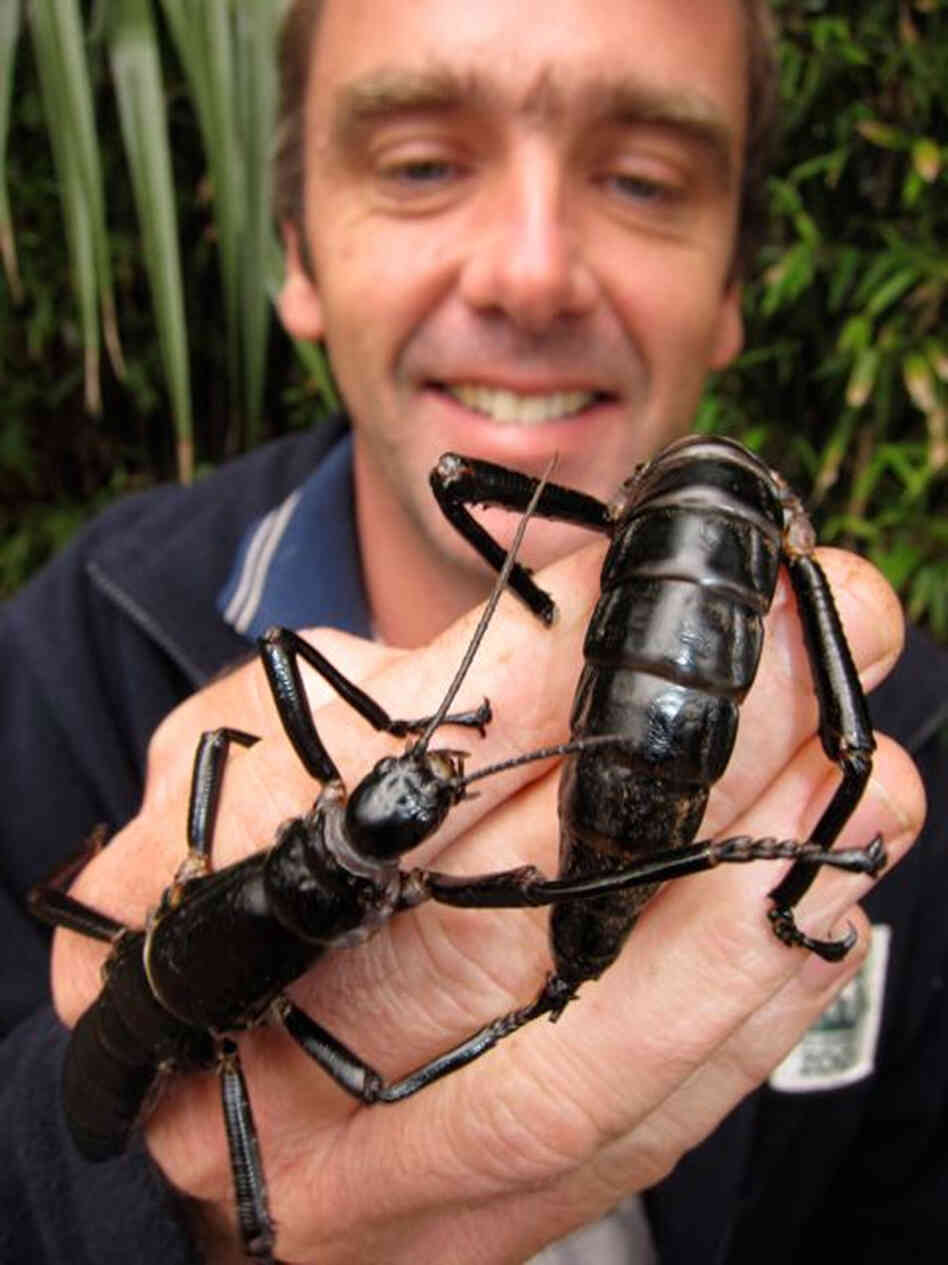
Patrick is the guy in the middle. The one with hands.
Eve nearly died of
malnutrition, but “intuition” helped Patrick make a syrup of calcium and
nectar. He fed her drop by drop, like a kitten curled in his hand. A big, brown, six legged kitten. But she lived.
And she laid eggs! 30 hatched.
By 2008 there were over 11,000 eggs in incubation and over 700 adults in
captivity. The challenge now--right now-- is this:
can they return the Giant Australian Stick Bug to its original habitat on Lord
Howe island? Because first they’d have
to wipe out the entire rat population, and then convince the human islanders to
welcome back giant hard shelled insects because
they belong there.
Who wouldn't want a yard full of giant bugs? Why not see one next to the toilet at night?
No really though. Will we ‘save’
them, if it's in our power, or will we keep them museums? We have the power. What will we do?
This isn’t just a conservation story. It’s a question about whether we as a human
race are going to reclaim our role as stewards of the planet because we believe in
the resurrection. Whether our belief in a resurrected Christ
translates to a belief that resurrection is possible for the world itself—not the
annual rejuvenation of Spring, but an actual return from the dead. Can we help bring to life that which we kill?
It’s a question about whether we are prepared to receive the
Holy Spirit, to forgive and retain the
sins of others and ourselves. We have a great responsibility to hold ourselves and others responsible for what we have done. There is no forgiveness with mere forgetting, no release without work.
The resurrection matters to the natural world,
but only when it matters to us.
May we receive the Spirit, and find more resurrection. Amen.
[2] http://www.workingpreacher.org/narrative_podcast.aspx?podcast_id=504,
start at the 2:25 mark
[3] http://www.npr.org/blogs/krulwich/2012/02/24/147367644/six-legged-giant-finds-secret-hideaway-hides-for-80-years
Not in love with the idea of baby Giant Australian Stick Bugs yet?
awwww. You should sit back and watch this for six minutes.
It's very chill.
What would Jesus do?
He'd totally hug a stick bug. Very gently.

No comments:
Post a Comment